


%402x.svg)
Discover why nonstop hustle culture sabotages executive performance and learn how circadian rhythms, 90-minute deep work blocks, and evening recovery habits create sustainable productivity.
Why Hustle Culture Fails and How Dr. Christian Poensgen Redefines High Performance
Every ambitious professional understands the pressure to do more, move faster, and stay connected around the clock. Yet modern workplace data reveals an unsettling paradox. While executives work longer hours than ever, engagement remains low and chronic exhaustion is at an all-time high. Many leaders find themselves sleeping seven or eight hours on paper, only to wake up completely drained, wondering why their effort fails to translate into clarity.
This unsustainable grind is precisely why Dr. Christian Poensgen teamed up with executive coach Eric Partaker to publish Ultraproductive: The 90-Minute Method to Optimize Focus, Sleep, and Stress. Holding a PhD summa cum laude on the relationship between stress and performance, Dr. Poensgen previously served as Senior Fellow of the Future of Work think tank in the German Federal Parliament and co-founded the European Center for Digital Competitiveness at ESCP Business School. His insights offer a refreshing, evidence-backed departure from conventional hustle culture, demonstrating that high output does not require physical depletion.
The central thesis of sustainable productivity is that humans are biological organisms designed to oscillate between intense effort and deliberate recovery. When you understand how your nervous system, sleep architecture, and circadian rhythms operate, you can double your meaningful daily output while systematically eliminating burnout.
Acute Stress vs Chronic Stress: Protecting Your Cognitive Edge
To build a sustainable career, you must first dismantle the myth that all stress is toxic. Stress is a fundamental biological prerequisite for growth, learning, and cognitive performance. When you sit down to solve a complex strategic problem, draft an executive presentation, or launch a venture, your sympathetic nervous system activates, increasing alertness and sharpening attention.
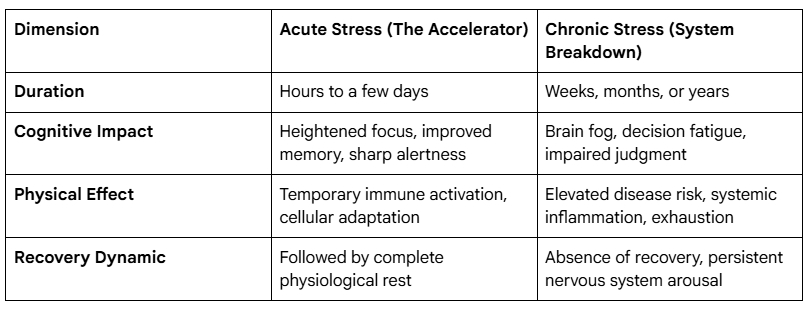
When leaders operate under acute stress followed by adequate recovery, capabilities expand much like muscle tissue responding to resistance training. However, when work demands remain relentless without intentional deceleration, acute activation shifts into chronic strain. Over time, chronic stress impairs the immune system and dramatically elevates the long-term risk of cardiovascular and neurodegenerative conditions.
How do you know where you stand on this spectrum? Dr. Poensgen suggests that the most reliable diagnostic tool is your sleep quality. If you continue to experience restorative, uninterrupted sleep and wake up with high energy, your system is successfully processing acute demands. If your sleep deteriorates and morning fatigue becomes standard, chronic stress has taken hold.
Restoring Sleep Architecture: The Two Macronutrients of High Performance
Many professionals assume that getting enough rest is purely a matter of spending seven or eight hours in bed. Yet waking up tired after a full night in bed is a widespread complaint, often caused by what researchers call junk sleep. Just as empty calories provide volume without nutrition, junk sleep provides hours without cellular restoration.
High-performance rest depends on securing adequate amounts of two vital sleep macronutrients:
- Deep Sleep (Slow-Wave Physical Restoration): Concentrated in the first three to four hours of the night, deep sleep is responsible for cellular repair, muscle growth, metabolic regulation, and clearing metabolic waste from brain tissue.
- REM Sleep (Emotional and Cognitive Therapy): Predominantly occurring in the second half of the night, REM sleep processes emotional experiences, consolidates complex learning, and integrates memory.
If you miss your biological window for deep sleep during the early part of the night, sleeping in later will not compensate for the deficit. Dr. Poensgen identifies three practical habits to safeguard your deep sleep:
– Establish a 90-Minute to 3-Hour Dinner Cutoff: Falling into deep sleep requires core body temperature to decrease by roughly 1°C (around 1° to 2°F). When you consume heavy meals or late-night snacks close to bedtime, active digestion elevates metabolic temperature and heart rate, directly suppressing slow-wave sleep.
– Minimize Evening Autonomic Arousal: Exposure to harsh blue light suppresses melatonin production, delaying your circadian sleep signal. Equally important is avoiding highly stimulating content, such as sensational news feeds or contentious social media threads, that activates your nervous system before bed.
– Anchor a Consistent Wake-Up Time: Your morning wake-up time is the primary anchor that sets your 24-hour circadian clock and dictates cortisol and melatonin timing. While sleeping an extra hour on weekends is harmless, shifting your schedule by two or three hours creates social jet lag that undermines weekly sleep quality.
Mastering Deep Work: The 30-3-11 Rule and Intermittent Digital Fasting
In today's corporate environment, the average professional lives in a fragmented five-minute reality, constantly interrupted by incoming notifications, reactive emails, and back-to-back video meetings. This persistent task-switching creates severe cognitive friction, preventing deep concentration.
Cognitive research demonstrates that dedicating 60 to 90 minutes each day to single-task focus can double meaningful strategic throughput. Rather than fighting your biology, schedule your most demanding intellectual work during natural circadian alertness windows. The 30-3-11 framework highlights three daily windows where focus naturally peaks:
- 30 Minutes Post-Waking: An early window of rising alertness suitable for setting strategic priorities.
- 3 Hours Post-Waking: The primary cognitive peak for complex analytical problem-solving and creative output.
- 11 Hours Post-Waking: A secondary late-afternoon surge ideal for synthesis, final execution, or physical training.
Between 1:00 PM and 3:00 PM, most individuals experience a post-lunch dip where vigilance declines. Rather than forcing high-stakes analytical work during this trough, utilize this period for routine administrative tasks, low-friction meetings, or a 15-to-30-minute restorative break.
To protect personal recovery outside the office, Dr. Poensgen recommends combating time confetti, the fragmentation of downtime caused by checking devices in small bursts. By implementing intermittent digital fasting, you place your smartphone in another room 30 to 90 minutes before sleep and delay checking it during the first 30 minutes of the morning, converting scattered moments into restorative rest.
"To go fast in life, you need great brakes." -- Dr. Christian Poensgen
Overcoming the Ambition Trap: Building Sustainable Executive Habits
When high-achieving professionals decide to optimize their health or work habits, their biggest obstacle is rarely a lack of desire. Paradoxically, excessive ambition often sabotages long-term behavioral change. When you set overly aggressive initial targets, such as attempting a grueling new daily workout routine or an intense multi-hour focus block overnight, consistency rapidly collapses the moment initial motivation wanes.
Lasting behavioral change follows a micro-habit framework:
- Shrink the Initial Hurdle: Make the starting behavior so small that resistance is virtually zero. If committing to 90 minutes of uninterrupted focus feels daunting, begin with a structured 10-minute block.
- Prioritize Consistency Over Intensity: Going from zero to one is the hardest step in human behavior. Once a micro-habit is established in your routine, expanding from 10 minutes to 30 or 60 minutes requires minimal willpower.
- Sequence Creative Work Before Reactive Demands: Protect the first 30 to 60 minutes of your workday for proactive, needle-moving initiatives before opening email clients or messaging channels.
Frequently Asked Questions
Who is Dr. Christian Poensgen?
Dr. Christian Poensgen is a scientist turned executive coach, author, and researcher specializing in stress, focus, and performance. He holds a PhD summa cum laude on the interplay between stress and performance and is the co-author of Ultraproductive alongside Eric Partaker.
What is the 90-minute method in Ultraproductive?
The 90-minute method is an optimization framework that structures high performance around natural human biological rhythms. It emphasizes 60-to-90-minute blocks of uninterrupted deep work, targeting approximately 90 minutes each of deep and REM sleep nightly, and introducing periodic recovery breaks throughout the workday.
What is the difference between acute and chronic stress?
Acute stress is a short-term physiological response lasting hours or days that sharpens attention, boosts focus, and strengthens resilience when followed by adequate rest. Chronic stress persists over weeks or months without recovery, leading to cognitive fatigue, hormonal dysregulation, and burnout.
How does dinner timing affect sleep quality?
Digesting heavy food requires significant metabolic energy and keeps core body temperature elevated. Because deep restorative sleep requires core body temperature to drop by roughly 1°C, finishing your final meal 90 minutes to 3 hours before bed allows your body to cool down and initiate slow-wave sleep on schedule.
What is the 30-3-11 rule for daily focus?
The 30-3-11 rule is a circadian scheduling heuristic that identifies peak cognitive alertness windows occurring roughly 30 minutes, 3 hours, and 11 hours after waking up. Aligning difficult, high-concentration tasks with these windows maximizes productivity.
What is intermittent digital fasting?
Intermittent digital fasting is the practice of setting deliberate screen-free boundaries around your day. It involves placing smartphones away 30 to 90 minutes before bedtime and for the first 30 to 60 minutes upon waking to prevent attention fragmentation and support deep sleep.
- To get practical tools and actionable tips that will jumpstart your journey, download the Kick Starter Booklet here.
- Join the newsletter to be notified when a new episode is ready for you to listen and get every Kick Starter Booklet for all future episodes.
- And if you’re looking to elevate your entire C-Suite leadership team, learn how Craig Dowden can help your leaders perform at their highest-level visit https://www.craigdowden.com/executive-mastermind
- For a deeper dive, listen to the full-length episode of the Do Good to Lead Well podcast featuring Christian Poensgen:
Check out these articles to help hone your skills even further:
- Eliminate Meeting Debt: How to Fix Broken Meetings: Eliminate Meeting Debt, Master the 4D CEO Framework, and Reclaim Focus with Dr. Rebecca Hinds
- Advance Your Career: How to Manage Up at Work: Master Stakeholder Dynamics and Advance Your Career with Melody Wilding
- Drive Transformation: Data-Inspired Leadership: Why Psychological Safety and Inquiry Drive Transformation with Sebastian Wernicke
- Onboarding New Team Members: How Onboarding New Team Members Builds Collective Confidence with Dr. Andre Martin
- Redefine AI Adoption: Workforce Intelligence: How OneDigital's Mike Sullivan Is Redefining AI Adoption
- Part 3, Purposeful Leadership: What Is Purposeful Leadership and Why It Matters with Kevin Ford
- Part 2, Respect, Empathy, and Connecting With Others: What Does Respect Mean at Work? Kevin Ford on Respect, Empathy, and Connecting With Others
- Part 1, Build a 360° Feedback Process: Part 1: Self-Awareness in Leadership — How Top CEOs Build a 360° Feedback Process That Works, Featuring Kevin Ford, Former CEO of Calian Group
- Sabbatical Leave: The Benefits of Sabbatical Leave: What DJ DiDonna's Research Actually Shows
- Difficult Conversations: How to Have a Difficult Conversation Without Repeating It Next Month
- Getting Honest Feedback: Why Senior Leaders Stop Getting Honest Feedback (And What to Do About It) with Craig Dowden
- Actually Get Results: How to Be Yourself at Work and Actually Get Results: Lessons from Claude Silver, Chief Heart Officer at VaynerX
- Stop Being Overlooked: How to Build Unforgettable Presence: Proven Strategies for Introverts, Leaders, and Anyone Who Wants to Stop Being Overlooked with Lorraine K. Lee
- Stop Playing It Safe: How to Stop Playing It Safe and Lead at Your Full Potential: Insights from Dianna Fioravanti
- Lead with Authentic Integrity: How to Lead with Authentic Integrity: Lessons from a Financial Markets CEO with Laura Paglia

Sign up to hear Craig’s latest perspectives and more.
Craig Dowden


%401x.svg)
